Same Couch, Same Screen, Serious Money: The Local Co-Op Revival Nobody Saw Coming
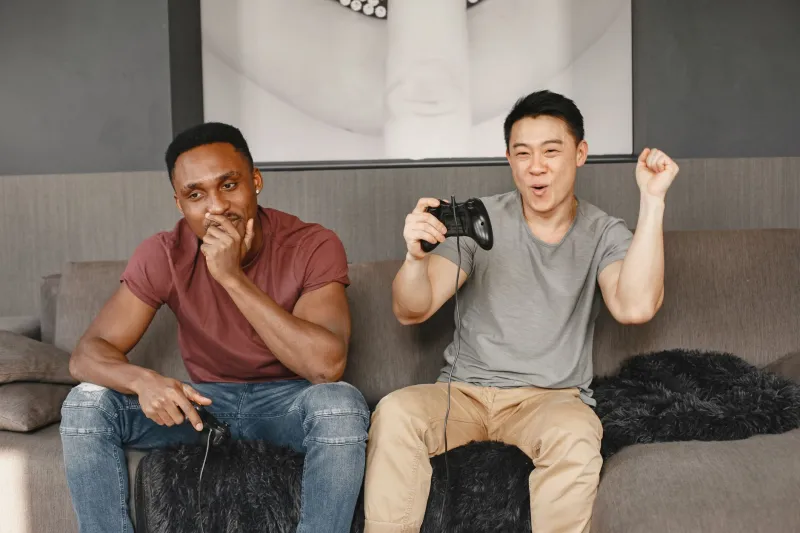
Couch co-op gaming was supposed to be dead. Publishers buried it, online multiplayer replaced it, and for a solid decade, sharing a screen felt as outdated as blowing into a cartridge. Then something weird happened — players started demanding it back, and a handful of smart developers turned that nostalgia into a gold rush.
Welcome to the playground, folks. Pull up a cushion.
How Publishers Convinced Themselves Nobody Wanted This
The funeral for couch co-op started sometime around 2010. Broadband internet had finally reached enough American households that online multiplayer became the default assumption for any game with more than one character. Why build a split-screen mode when you could just... not? It saved development time, cut QA costs, and conveniently pushed players toward online ecosystems loaded with microtransactions and battle passes.
The industry logic was clean, even if it was a little cold: online multiplayer scales infinitely. Local co-op tops out at however many people can physically fit on your couch. From a pure revenue-per-feature standpoint, the math seemed obvious.
What that math missed was the reason people play games together in the first place.
Online multiplayer solved a logistical problem — how do you play with someone across the country? — but it created a social one. Headsets get muted. Lobbies fill with strangers who have a lot of opinions about your skill level. The shared joy of a couch session, where you can see your friend's face when they accidentally blow you both up, just doesn't survive a 200-ping connection and a Discord argument.
The Games That Proved the Market Was Still There
It Takes Two didn't just win Game of the Year at The Game Awards in 2021 — it rewrote the conversation entirely. Hazelight Studios built an entire experience around the idea that two people, in the same room or online, would play through a story together, with mechanics that actually required cooperation rather than just proximity. It sold over 12 million copies. Twelve million.
That number landed like a thunderclap in boardrooms that had written off the genre.
But It Takes Two wasn't an isolated incident. Overcooked had already been quietly proving for years that a chaotic, shared-screen cooking game could become a cultural phenomenon — a staple at parties, a couples' activity, a family game night staple that actually made adults put their phones down. The Jackbox Party Pack series built an entire business model around the idea that one person streams to a TV while everyone else plays on their phones. Unravel Two, Moving Out, Pode — a steady drip of games that understood something the big publishers had forgotten.
People want to play with someone they can actually look at.
The Indie Engine Driving the Revival
Here's where it gets interesting for anyone paying attention to where gaming money is actually flowing right now. The couch co-op resurgence isn't being led by Activision or EA. It's being built, almost entirely, by indie and AA studios who spotted the gap and sprinted into it.
Games like Pode, Degrees of Separation, and more recently titles like Cataclismo and Biped have found audiences precisely because the big players aren't competing in the space. The barrier to entry is lower — you don't need 64-player server infrastructure or an anticheat team — and the audience, it turns out, is massive and underserved.
That underserved quality matters. When a genre gets abandoned by the mainstream, the players who still love it become intensely loyal to anything that shows up and delivers. Couch co-op fans aren't casual about their appreciation. They remember what it felt like to play Halo 2 in split-screen with their college roommate at 2 a.m., and they will throw money at any modern game that recreates even a fraction of that feeling.
The Toxicity Angle Nobody's Talking About Enough
There's another reason couch co-op is winning right now that goes beyond nostalgia, and it's a little uncomfortable to say out loud: online multiplayer gaming has a serious toxicity problem, and a lot of players are exhausted by it.
Ranked lobbies, competitive griefers, harassment in voice chat, smurfs ruining casual matches — the online multiplayer experience in 2025 can feel less like a playground and more like a job with a terrible HR department. Parents who want to game with their kids can't always trust what's waiting for them in an online lobby. Couples who want a low-stakes shared experience don't necessarily want to be screamed at by a teenager in another time zone.
Couch co-op sidesteps all of that. The only person who can grief you is physically present in your living room, and presumably you like them enough to have invited them over. The social contract is completely different — cooperative instead of competitive, patient instead of punishing, fun instead of performative.
That shift in energy is exactly what a significant chunk of the gaming audience has been quietly craving.
What AA Studios Are Starting to Figure Out
The truly interesting development in 2024 and into 2025 is that mid-tier studios — the AA space that often gets overshadowed in conversations dominated by indie darlings and AAA blockbusters — have started paying attention. Games with modest budgets but serious production values are starting to ship with robust local co-op modes not as afterthoughts, but as central design pillars.
This is meaningful because AA studios have just enough resources to polish an experience without the corporate mandate to chase every trending monetization scheme. They can build a complete, contained couch co-op game and sell it at a fair price without needing it to support a live-service ecosystem. That's a sweet spot that the market is currently rewarding.
The numbers back it up. Steam data, social listening on platforms like Reddit and TikTok, and actual sales figures from titles in the genre all point in the same direction: when a good couch co-op game drops, people buy it, play it with someone they care about, and tell other people about it. Word-of-mouth marketing in gaming doesn't get more powerful than that.
The Playground Is Getting Crowded Again — In the Best Way
JAOPG has always been about the idea that gaming is, at its core, a space where people come to have a genuinely good time. Not to optimize a build, not to grind a battle pass, not to perform skill for an audience of strangers — just to play, together, and feel something.
Couch co-op has always been the purest expression of that idea. Two people, one screen, the same goal. It got lost for a while because the industry convinced itself that "together" had to mean "online." What we're watching right now is the market correcting that mistake in real time.
The developers who recognized that gap early are already counting the returns. The ones who are just now paying attention are scrambling to catch up. And the players — the ones who never stopped wishing they could just hand a controller to the person sitting next to them — are finally getting their playground back.
About time.