Split Screen, Divided World: The Slow Death of Gaming's Greatest Social Ritual
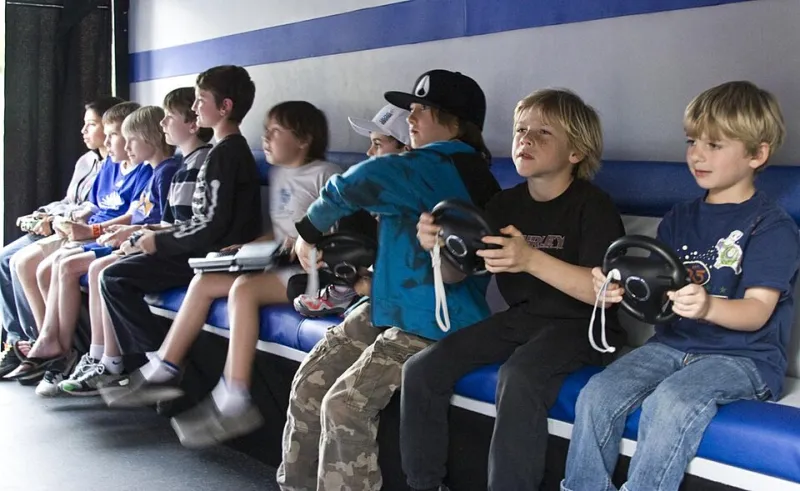
Photo: Gamesingear, CC BY-SA 3.0, via Wikimedia Commons
Picture this: It's 2003. You've got two controllers, a CRT television that weighs roughly as much as a small refrigerator, and your best friend is sitting close enough that you can elbow them when they screen-peek in GoldenEye. Nobody's on a headset. Nobody's checking their phone. You're just there, together, sharing a couch and a bag of Doritos and something that felt, at the time, completely unremarkable.
Now picture trying to recreate that in 2025.
You'd need to coordinate schedules across two or three different households, download the same game on the same platform, hope the servers aren't having a rough night, and communicate through a microphone that occasionally picks up your roommate's TV in the background. It's not impossible. It's not even bad, honestly. But it is different in ways that are worth sitting with for a minute.
At JAOPG, we spend a lot of time thinking about what gaming is — not just as entertainment, but as a cultural force that shapes how people connect. And the couch co-op question is one that keeps coming up, because it gets at something fundamental: what happens to a social experience when you strip out the physical proximity?
The Golden Age Nobody Called 'Golden' at the Time
Here's the thing about nostalgia — it always sneaks up on you. Nobody in 1998 was going around saying, "Man, this split-screen Crash Team Racing era is really something special. I hope future generations appreciate it." You just played. You just existed in the same space as people you cared about, and the game was the excuse.
The golden age of local multiplayer roughly spans from the mid-'90s through the early-to-mid 2000s, when titles like Mario Kart 64, Halo: Combat Evolved, Tony Hawk's Pro Skater 2, and Mortal Kombat defined entire social scenes. College dorms. Basement hangouts. Sleepovers that ran until 3 AM because nobody wanted to be the first to call it.
Developers built around the assumption that multiple bodies would be in the same room. The hardware demanded it — online infrastructure was either nonexistent or brutally unreliable for the average household. Constraints created culture, as they often do.
Then broadband internet showed up and changed the math entirely.
What We Gained (And It's Actually a Lot)
Let's be honest about this: online multiplayer has been genuinely transformative in ways that deserve real credit. The ability to play with a friend who moved across the country, or to find opponents who actually challenge you at 11 PM on a Tuesday, or to build communities around games that no single geographic area could sustain — that's not nothing. That's enormous.
For a huge portion of the gaming population, online play didn't replace couch co-op. It replaced nothing, because they never had the couch to begin with. Rural players who grew up without nearby friends. People with social anxiety who found connection easier through a screen. Adults with kids and jobs and lives that don't allow for casual hangouts.
Online multiplayer democratized the social side of gaming in ways that are easy to overlook when you're feeling sentimental about the old days.
And platforms like Steam Remote Play Together, PlayStation's Share Play, and even Nintendo's online offerings have genuinely tried to bridge the gap — letting players share local-style experiences across distances. The technology is getting better. The intent is there.
What We Lost (And It's Harder to Name)
But something did change. Something harder to quantify than ping times or player counts.
When you're playing a game in the same room as someone, you're sharing everything — the lag spike that kills you both, the moment the power flickers, the smell of pizza, the way your friend physically reacts when they get eliminated. You're reading body language. You're laughing at the same frame of animation at the same millisecond. You're present in a way that no headset or video call has yet managed to replicate.
Gaming historians and researchers who study play behavior consistently point to something called "co-presence" — the feeling of genuinely sharing a space with another person. Online connectivity gets close. It doesn't get there. There's still a layer of mediation, a thin but persistent membrane between you and the other player, that changes the texture of the experience.
And developers noticed. Not all of them, but enough. The gradual disappearance of split-screen modes from major AAA titles through the late 2000s and 2010s wasn't just a technical decision — it was a signal about what the industry thought gaming's social future looked like. Online was the investment. Local was the legacy feature nobody wanted to maintain.
The Indie Scene Kept the Candle Lit
While the big studios were quietly sunsetting local play, indie developers were doing something interesting: keeping it alive on purpose.
Games like Lovers in a Dangerous Spacetime, Overcooked, It Takes Two, and Towerfall Ascension weren't just good co-op games — they were arguments for couch co-op as a design philosophy. They were built around the idea that physical proximity is a feature, not a limitation. The chaos of Overcooked only works because you can see your partner's face when they set the kitchen on fire. It Takes Two won a Game of the Year award partly because it understood that some emotional experiences land differently when you're sitting next to someone.
These games proved there was still hunger for it. That the ritual hadn't died, just been underserved.
So Is It Nostalgia or Real Loss?
Honestly? Both. And that's not a cop-out.
Nostalgia is real loss filtered through memory. When people say they miss couch co-op, they're usually saying they miss the conditions that made it possible — the free time, the proximity to friends, the era before everyone's social life got distributed across a dozen different platforms and cities. The game was never really the point. The people were.
Online multiplayer didn't kill that. Life did, mostly. Growing up did. The way American social infrastructure has quietly made it harder for adults to maintain close physical friendships — that's doing more damage to the couch co-op tradition than any broadband connection ever could.
But the games could help. Developers could make more of them. Publishers could stop treating local multiplayer as a checkbox feature and start treating it as a genuine design priority. Hardware makers could stop assuming that every household only has one serious player.
Because here's what we know at JAOPG: the playground is more fun when everyone's actually on it. Not just connected to it — on it. In the same yard. Arguing about who screen-peeked.
Some things don't travel well through a cable. Turns out shared space might be one of them.